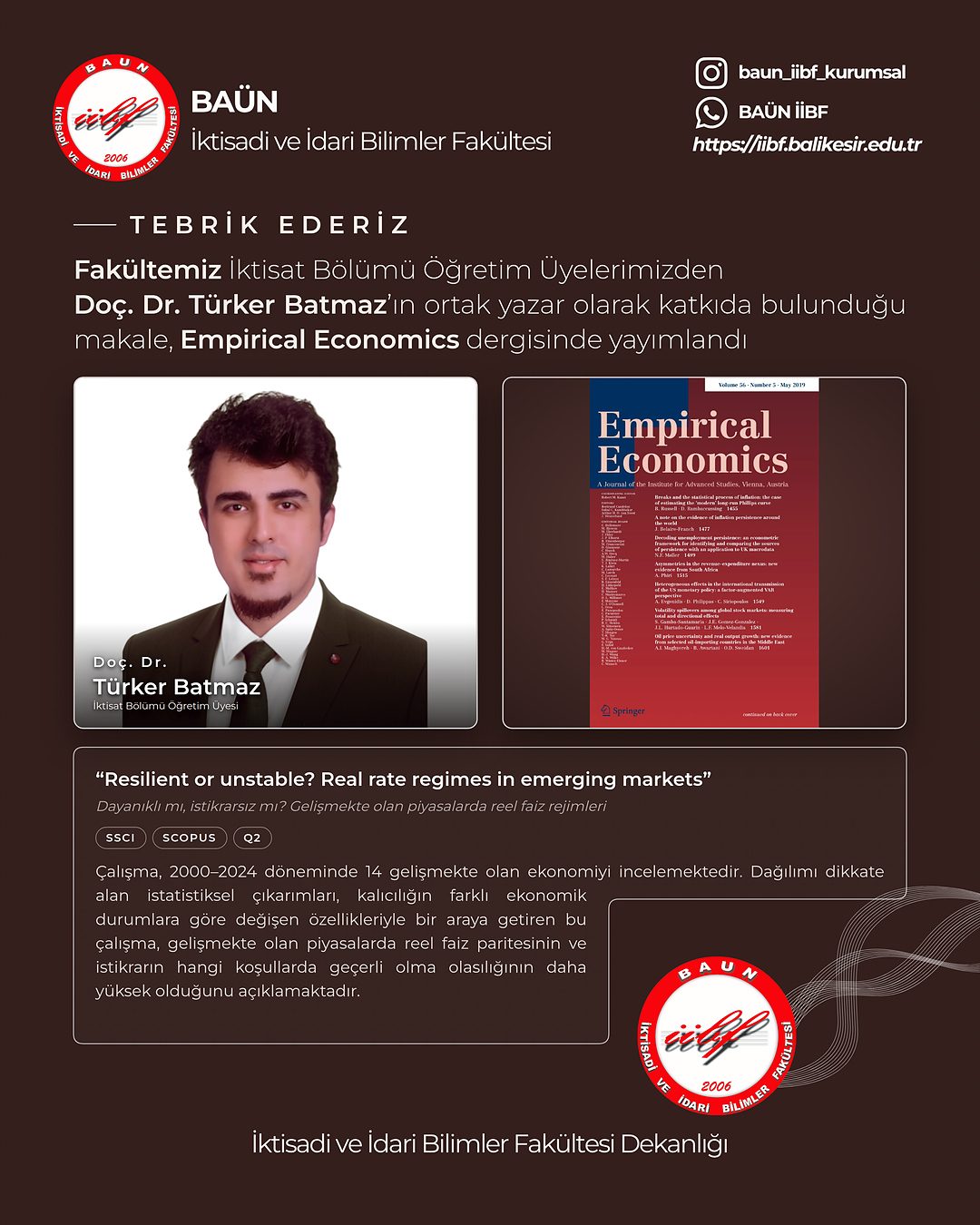
Congratulations...
The article entitled “Resilient or unstable? Real rate regimes in emerging markets”, co-authored by Associate Professor Türker Batmaz, a faculty member of our Department of Economics, has been published in Empirical Economics. The journal is indexed in the SSCI and Scopus databases and is ranked in the Q2 category.
Using monthly data from fourteen emerging economies for the 2000–2024 period, the study examines the mean-reverting behaviour of real interest rates and whether this behaviour changes under different economic conditions. The findings indicate that real interest rates tend to revert to their mean under low and moderate interest-rate regimes, whereas this tendency weakens or disappears under high interest-rate regimes.
Accordingly, shocks to real interest rates become more persistent during periods of economic stress, and interest-rate dynamics differ from those observed under normal economic conditions. The study also finds that inflation remains stationary across the entire distribution, while regime-dependent differences in real interest rates are primarily driven by nominal interest rates.
A comparison with advanced economies reveals that the persistence observed during high interest-rate periods is more pronounced in emerging markets. Traditional mean-based tests may overstate overall stationarity due to the influence of relatively stable periods and may therefore fail to detect instability during high interest-rate regimes.
This pattern is associated with the tendency to limit exchange-rate fluctuations, rising sovereign and exchange-rate risk premia, and the transmission of global monetary policy and US dollar funding shocks to domestic nominal interest rates. The study consequently emphasizes that the stability of real interest rates in emerging markets depends on prevailing economic conditions and that the validity of real interest rate parity may vary across different periods.
We congratulate our esteemed faculty member on this valuable contribution to the scientific literature and wish him continued success in his academic studies.