How Do G-7 Countries Manage Resources? A Clean Energy, Trade and Development Analysis by a BAUN Academic
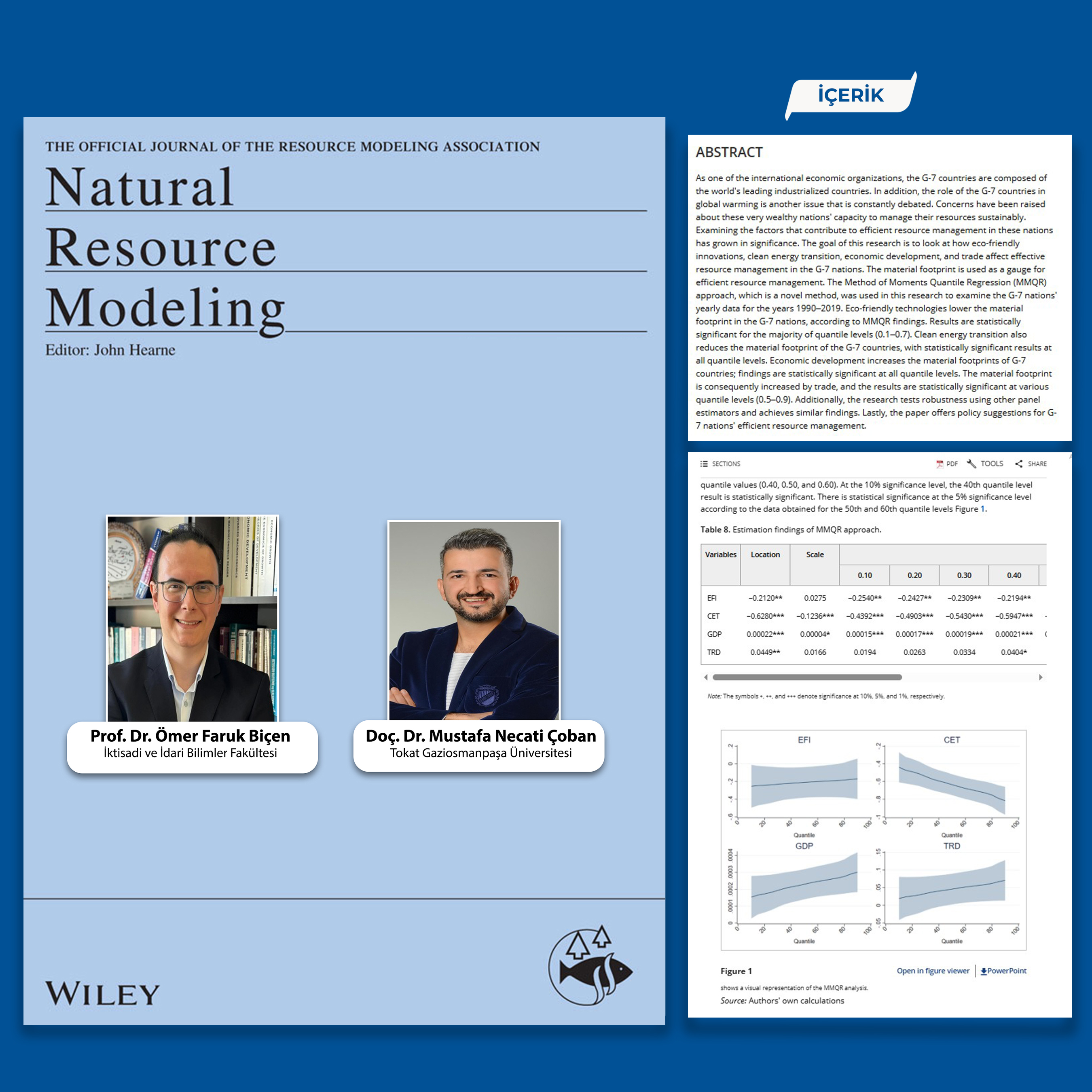
The academic study signed by scholars including Prof. Dr. Ömer Faruk Biçen from Balıkesir University (BAUN) Faculty of Economics and Administrative Sciences contributes significantly to the literature by revealing, through modern indicators, the effects of clean energy transition, economic development, and international trade on effective resource management in G-7 countries.
Conducted by Prof. Dr. Ömer Faruk Biçen from BAUN and Assoc. Prof. Dr. Mustafa Necati Çoban from Tokat Gaziosmanpaşa University, the study titled “The Path to Effective Resource Management: Exploring the Impact of Eco‐Friendly Innovations, Clean Energy Transition, Economic Development and Trade in G‐7 Countries” was published in the SCIE-Q2 indexed journal Natural Resource Modeling, which ranks among the top tiers of international journals.
Prof. Dr. Ömer Faruk Biçen: “We Focused on Material Footprint Instead of CO2”
Providing information about the research, Prof. Dr. Ömer Faruk Biçen stated that G-7 countries have long been a subject of debate due to their high level of industrialization and their role in environmental pollution and global warming, emphasizing that examining the factors contributing to efficient resource management in these countries has become increasingly important.
Prof. Dr. Ömer Faruk Biçen noted that while researchers generally focus on CO2 emissions in environmental and global warming studies, high-income countries such as the G-7 tend to relocate pollution-intensive production processes to developing countries, resulting in relatively lower domestic CO2 emissions. Therefore, the study preferred a consumption-based material footprint indicator to measure environmental impacts more accurately.
Emphasizing that the material footprint provides a more comprehensive measurement of environmental impacts, Prof. Dr. Ömer Faruk Biçen stated that although this concept exists in the literature, a detailed analysis focusing on G-7 countries had not previously been conducted. He added that the study employed the Method of Moments Quantile Regression approach, enabling the analysis of how resource management evolves at different levels.
Analyzing data covering the period 1990–2019, Prof. Dr. Ömer Faruk Biçen explained that eco-friendly innovations and clean energy transition reduce the material footprint, while economic development and trade increase resource consumption at certain levels.
Prof. Dr. Ömer Faruk Biçen emphasized that for effective resource management, G-7 countries should expand eco-friendly technologies, accelerate the transition to sustainable energy, and phase out fossil fuel use. He also highlighted the importance of strengthening recycling and circular economy practices, implementing policies that limit excessive consumption, extending product lifespans, and prioritizing environmentally friendly products.
Article link: https://onlinelibrary.wiley.com/doi/10.1111/nrm.70028