Sectoral Differences in Corporate Biodiversity Reporting: Striking Findings from BAUN Academicians
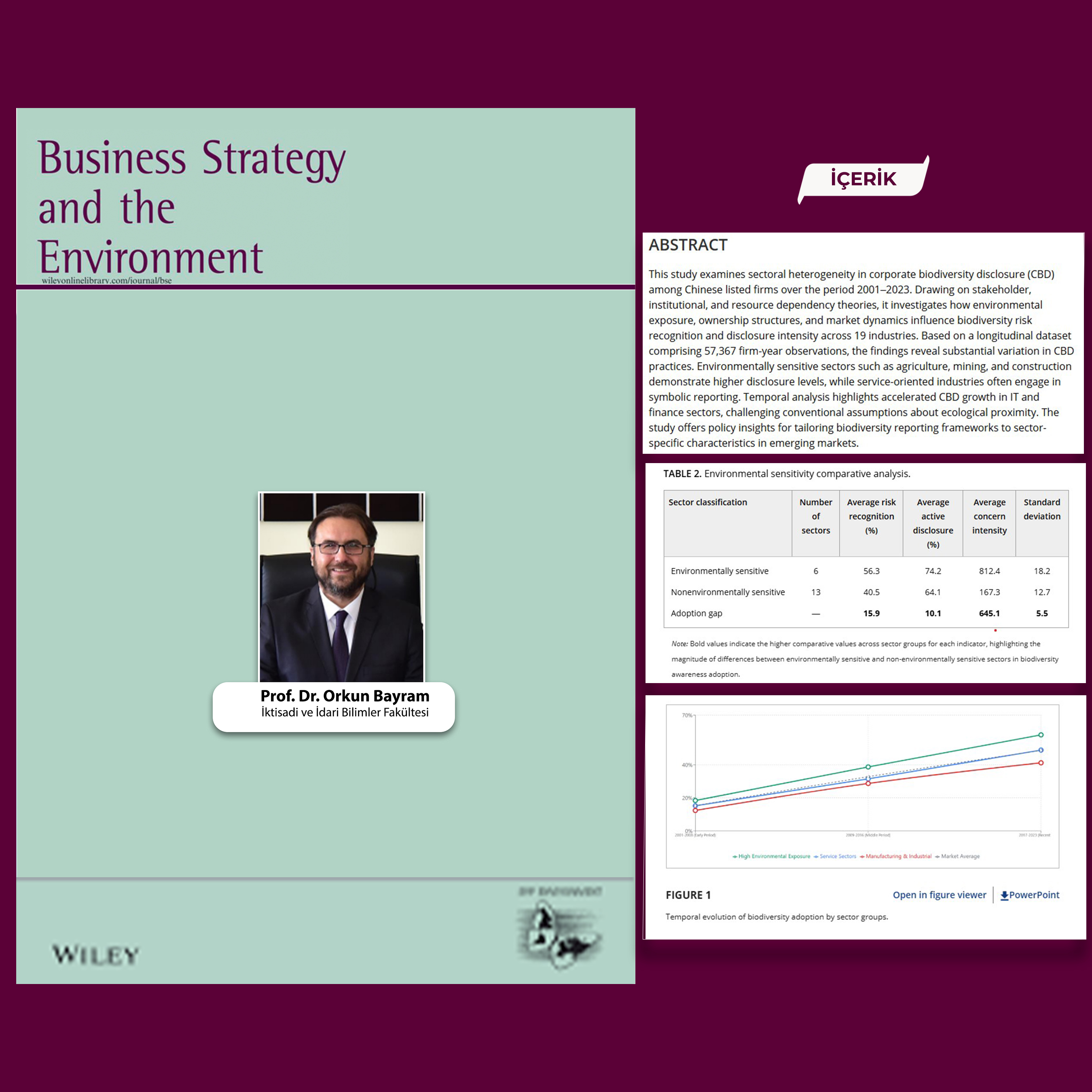
The academic study, lead-authored by Prof. Dr. Orkun Bayram, an academician from the Department of International Trade and Logistics, Faculty of Economics and Administrative Sciences at Balıkesir University (BAUN), and co-authored by other academicians, has made significant theoretical and empirical contributions to the literature by revealing the sectoral differences in corporate biodiversity disclosures (CBD).
The study titled “Sectoral Heterogeneity in Corporate Biodiversity Disclosure: Evidence from Chinese Listed Companies Across Industries, 2001–2023,” conducted by Prof. Dr. Orkun Bayram from BAUN, Assoc. Prof. Dr. Yavuz Selim Balcıoğlu, and Res. Asst. Dr. Irmak Aksoy from Doğuş University, was published in the Strategy and the Environment journal, which is in the SSCI-Q1 category, one of the top tiers of international journal rankings.
Prof. Dr. Orkun Bayram: “Our study presents important findings for understanding the sectoral dynamics of corporate biodiversity reporting.”
Providing information about the study, Prof. Dr. Orkun Bayram stated that sectoral differences, which are mostly treated as a secondary variable in existing studies, were placed at the center of the analysis in this research. In this regard, he noted that the study questioned the assumption that CBD practices have a homogeneous structure among firms and revealed that inter-sectoral differences are a systematic and meaningful phenomenon.
Emphasizing that the data, based on more than 57,000 firm-year observations obtained from companies listed on the Chinese Stock Exchange and covering the 2001–2023 period, met the need for a long-term and comprehensive sectoral comparison missing in the literature, Prof. Dr. Orkun Bayram stated that the relationship between environmental exposure and the level of disclosure was examined in detail in the study. He noted that the general assumption that sectors with high environmental impact make more disclosures was largely confirmed; however, he added that increasing disclosure trends were observed especially in sectors with limited direct environmental impact, such as information technology and finance.
Expressing that this situation shows disclosure behavior is shaped not only by environmental impacts but also by factors such as reputation management, investor expectations, and corporate legitimacy, Prof. Dr. Orkun Bayram stated that the study offers a more holistic explanation by combining stakeholder theory, institutional theory, and resource dependence theory.
Prof. Dr. Orkun Bayram emphasized that the research also covers the temporal dimension, which is mostly neglected in the CBD literature, and that sectors follow different development paths in the process of adopting biodiversity disclosures. Bayram stated that while disclosures spread rapidly in some sectors, more limited and gradual progress was observed in others; adding that this revealed sustainability reporting does not spread homogeneously across all sectors and that sector-specific dynamics are decisive.
Prof. Dr. Orkun Bayram stated that the study also presents important implications for policymakers, noting that uniform reporting frameworks applicable to all sectors may not always produce effective results and that flexible and differentiated regulations taking into account the unique characteristics of sectors are needed. Prof. Dr. Orkun Bayram said that the study fills a meaningful gap in the literature by both contributing to theoretical discussions and developing concrete, practice-oriented recommendations.
Article access link: https://onlinelibrary.wiley.com/doi/10.1002/bse.70854